
This Blog will be a little bit harder to grasp than the former ones,mailnly because mathematics remains abstract to most of us.
While one is an exact science and the other an artistic endeavour, it’s interesting to note painting owes a great deal to maths.
Geometry: An Essential Ingredient in Modern Drawing
Geometry is one of the first things which comes to our mind when we consider the link between mathematics and painting. It is a branch of mathematics whose objective is to study shapes in space.

Is drawing not the artistic arrangement of forms to create a composition? And is painting not derived from drawing?
The Golden Ratio: Maths Applied to Painting
The golden ratio is an excellent example of the link between mathematics and painting.
In ancient Rome, architects, painters, sculptors and designers understood the difference between an aesthetic work and a creation of chaos. They were greatly interested in this question and have studied how a work, though composed of unequal parts, may be aesthetically appealing.
Roman architect Vitruvius was one of the first to identify the golden ratio. The ratio can be used to create sequences, repeated infinitely within subsections of the same work.

The golden appears in the form of the Parthenon (Source: Emptyeasel.com)
Several mathematicians, including the famous Fibonacci, author of the Fibonacci sequence, have proven the existence of the golden ratio in nature Even the human body is defined by this famous ratio.
In painting, there exist the golden rectangle, the golden spiral, the golden triangle and the golden ellipse. Together these elements define precisely where each part of a painting must be located, in order that the whole be harmonious and pleasing to the eye.
Leonardo da Vinci: A Genius of Mathematics and Painting
Leonardo da Vinci is undoubtedly one of the greatest figures in the field of art, mathematics and engineering. A true genius, this inventor and artist lived from 1452 to 1519 and was the originator of may advances in maths technology, some well before their time. We owe him the notion of perspective, a fundamental concept in artistic representation.
In this drawing, Leonardo sets out various measures of a human body, in the form of one defined which is supposedly “perfect”. Among the dimensions represented, we see that by extending our legs, the shape formed by them and the ground is that of an equilateral triangle. Also, it shows how the combined length of our two straight arms is equal to our height.
In this work, Leonardo precisely measured and represented each part of the human body, proportional to the whole.

The golden ratio can also be seen in the Mona Lisa (Source: Juan Ángel Paniagua Sánchez)
As a mathematician, Leonardo da Vinci knows about the golden ratio, and uses it in many paintings. In the Mona Lisa, for example, the face subject’s face fits perfectly into a golden rectangle. The same is true of the proportions of her body which, from elbow to elbow, fits into a golden rectangle.
The Last Supper, painted between 1494 and 1497, also employs the golden rectangle, to which both the table and room depicted conform in their dimensions.

The Golden Ratio in The Last Supper (Source: Emptyeasel.com – Leonardo da Vinci)
If you want to make progress as a painter, you will need to spend some time on your elementary maths lessons and on becoming skilled in perspective and geometry.
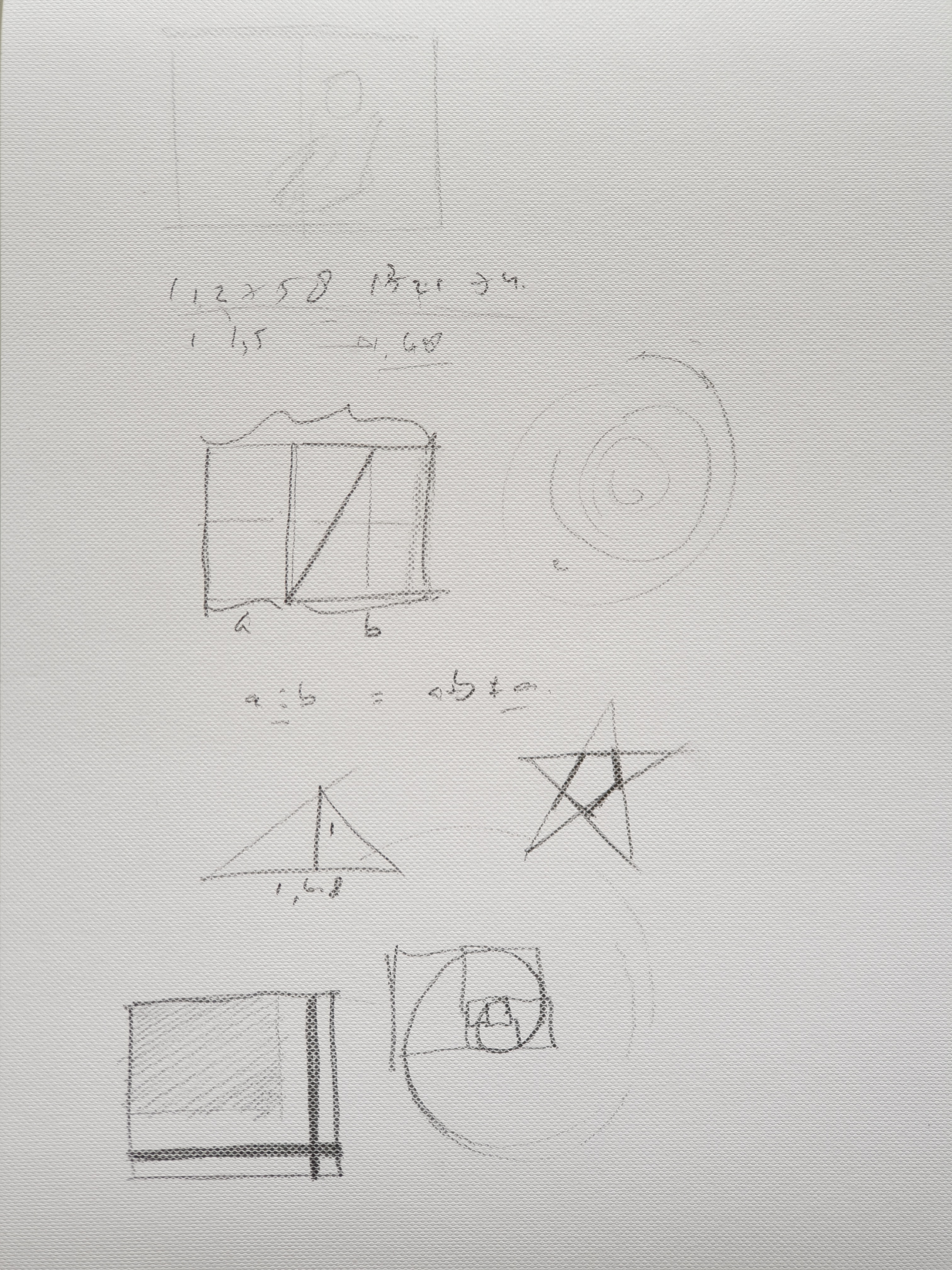
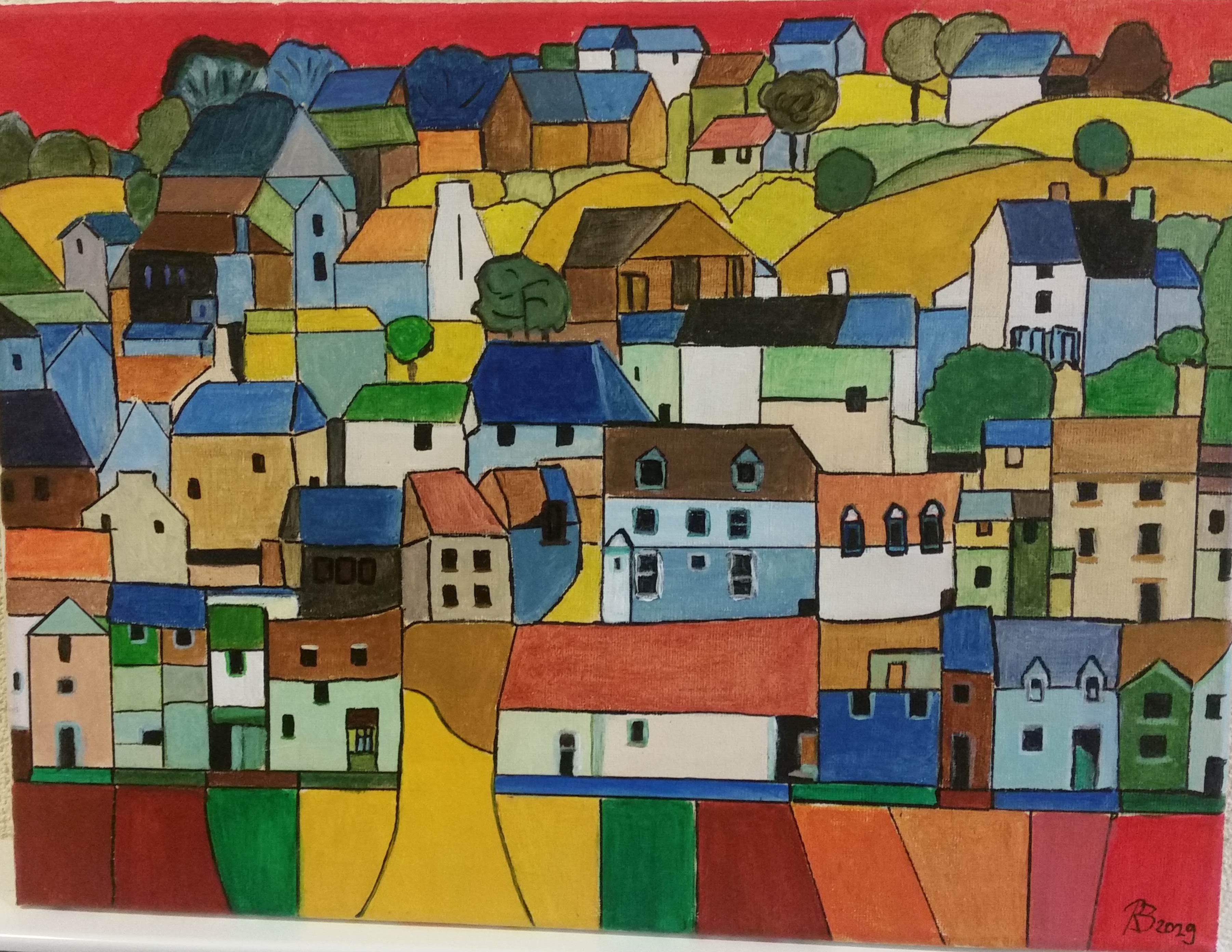
Although a main part of my academic studies existed of mathematics,until now I did not use it very explicitly in my painting attempts.Having said that I will present you however some homework and one geometrical painting,whereby some elementary maths has been “applied”.
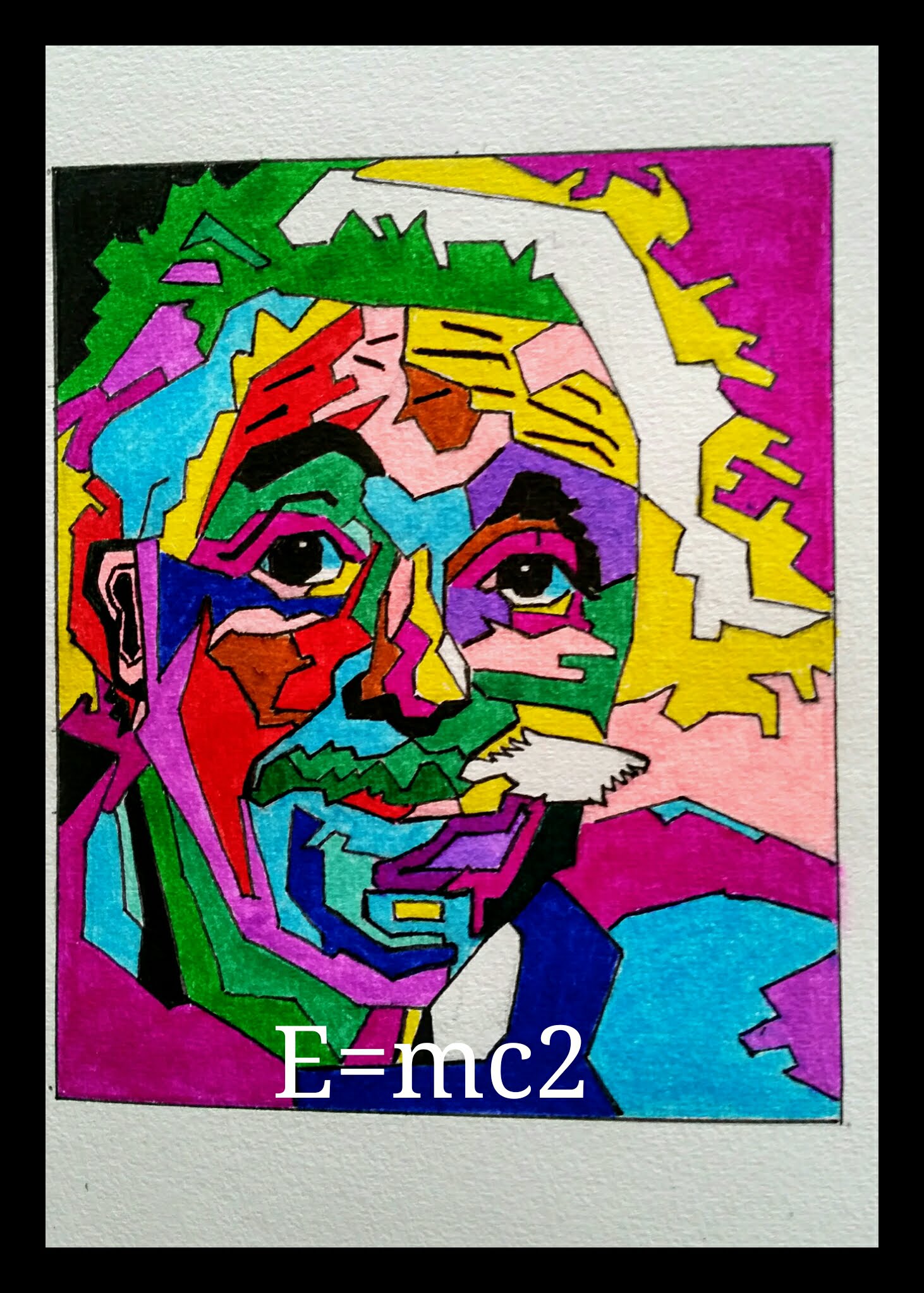
Let me conclude the chapter with a saying of one of my greatest heroes in science and creativity: Albert Einstein.
“After a certain level of technical skill is achieved, science and art tend to coalesce in aesthetics, plasticity, and form. The greatest scientists are artists as well”.
 Ruud's Gallery